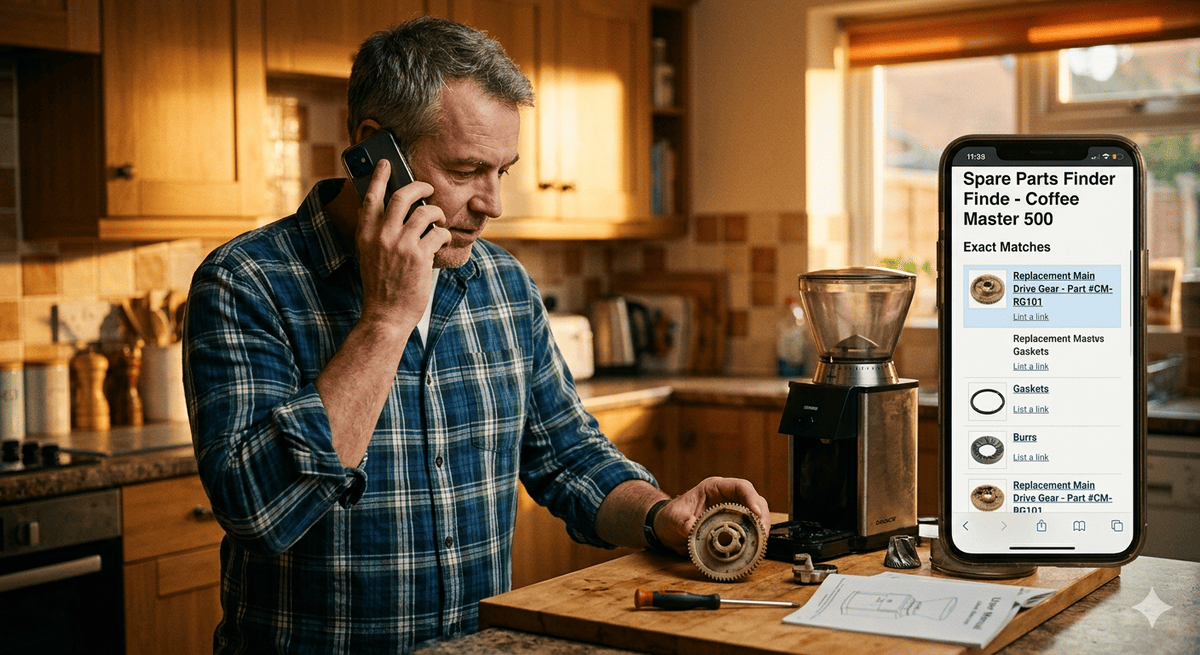
How Spare Parts Become Your Gateway to Customer Loyalty
Key Takeaways
- Aftermarket parts generate 40–60% gross margins versus 20–35% on the original product, making them one of the highest-margin revenue lines available to manufacturers.
- The primary reason customers abandon manufacturer parts channels is discovery friction — not price — with most purchases flowing to Amazon and grey-market sellers by default.
- Serialised digital product identity (unique QR per unit) eliminates compatibility guesswork and routes customers directly to the correct parts without requiring them to know their model number.
- Customers who make at least one direct parts purchase show 40–70% higher lifetime value than those who never re-engage through the parts channel.
The aftermarket is worth 3-5x the original sale. Most manufacturers are leaving almost all of it on the table.
A customer buys your commercial espresso machine for $1,400. Over the next five years, they'll spend an estimated $4,000–$7,000 on replacement filters, group head gaskets, portafilter baskets, and steam wand tips. If they can't find those parts quickly and confidently on your site, they'll find them on Amazon — or worse, buy a compatible knock-off from a third-party seller who now owns that customer relationship.
This isn't a niche problem. It's a structural failure that plays out across appliance manufacturers, power tool brands, HVAC equipment makers, and industrial equipment suppliers every single day. The initial sale is the opening move. The spare parts relationship is the actual game.
Why Aftermarket Parts Are Your Most Profitable Revenue Line
Aftermarket parts carry 40–60% gross margins — roughly double the 20–35% typical of original equipment sales. McKinsey research on durable goods confirms that spare parts and services can represent 25–50% of total manufacturer profits while accounting for a far smaller share of revenue. The margin differential exists because parts face no retail markdown pressure, carry low manufacturing complexity relative to finished goods, and benefit from the captive demand created by existing installations.
The revenue opportunity is large and largely uncaptured. A manufacturer with 200,000 units in the field and an average annual parts spend of $80 per active customer holds a $16 million revenue line. Most capture less than 20% of it. The remainder flows to Amazon marketplace sellers, grey-market resellers, and third-party distributors who invest nothing in product development. They simply harvest the post-sale relationship the manufacturer built. The strategic implication is direct: your parts catalogue is a recurring revenue asset, not a support function.
The Discovery Problem: Why Customers Can't Find What They Need
Customers who want to buy your parts are actively trying to give you money. The reason most of them end up on Amazon instead is not price — it is discovery friction. When a customer's product fails at 8pm, they have a narrow window of patience. If finding the right part on your site requires navigating multiple support pages, locating a model number from a two-year-old registration email, or calling a distributor for a compatibility check, they will leave. Amazon delivers a result — usually some result — in under thirty seconds. That speed advantage is not about logistics. It is about the absence of friction. Most manufacturer parts experiences impose friction at every step: buried catalogue pages, model-number requirements, no visual confirmation of fit, and no real-time stock data. Each friction point is a decision point where the customer weighs your channel against the alternative. Understanding which friction points are costing you sales is the prerequisite to fixing them.
Three Failure Modes That Lose the Sale
1. The buried catalogue. Parts pages exist somewhere in the support section, nested three or four levels deep below FAQs and warranty terms. A customer with a broken dishwasher door spring has maybe four minutes of patience before they open a new browser tab and search Amazon.
2. The model number maze. Finding the right part requires knowing the exact model and serial number. The customer registered the appliance two years ago and has no idea where that information lives. The product itself offers no help — there's no way to bridge from the physical object to the digital catalogue.
3. The compatibility guesswork. Even customers who find the catalogue often can't confirm compatibility. They're looking at a list of part numbers with no visual reference, no fit confirmation, and no indication of whether the item ships from stock or requires a six-week backorder.
Each of these failure modes has the same outcome: the customer goes elsewhere. They solve their immediate problem, and you lose not just that transaction but the re-engagement moment that parts purchases represent.
What Great Looks Like: Scan, Match, Order
The highest-performing aftermarket model answers one question clearly: what does a frictionless parts experience actually look like end to end?
The customer scans a QR code printed on the product itself — not in a manual, not on a registration card, but physically on the unit. The scan resolves to a product-specific page that already knows the model, serial number, and production batch. A parts section surfaces compatible components filtered to that exact unit, not a generic catalogue requiring manual filtering. Stock availability is live. Order placement is one or two steps. Confirmation arrives within minutes. There is no model-number lookup. There is no compatibility guesswork. There is no support call required. This is not an aspirational standard — it is what customers already experience from every other commerce interaction in their lives. The gap between that expectation and the experience most manufacturers currently deliver is precisely where aftermarket revenue is lost and where competitor relationships are formed.
The Role of Product-Level Digital Identity
The key enabler is serialised digital identity — a unique identifier tied to each individual product unit, not just the model. Generic QR codes that link to a model page are better than nothing, but they do not close the experience gap. A code that resolves to this specific unit, with its own registration history, service record, and compatible parts list, creates an entirely different interaction.
This is the connective tissue between physical ownership and digital commerce. Customers do not need to know their model number. They do not need to log in and search. They scan, and the product surfaces everything relevant to its own ownership experience.
The Loyalty Loop: Parts as a Re-Engagement Mechanism
A spare parts purchase is not just a transaction — it is a re-engagement event. When a customer scans your product to order a replacement part, you have their full attention at a moment of high intent. That moment is the entry point to a loyalty loop that compounds over time:
- Parts purchase — customer re-engages with the brand, demonstrates product attachment
- Post-purchase touchpoint — follow-up confirms delivery, offers installation guidance, surfaces accessories
- Cross-sell window — compatible accessories or the next-generation model become contextually relevant
- Retention signal — flag parts buyers for proactive outreach before the natural replacement cycle
Starting this loop does not require a sophisticated CRM — only connecting the parts transaction to a customer identity and building a minimal post-purchase sequence. Brands that instrument this report materially higher repurchase rates and longer customer lifetimes than those treating parts as fulfilment only. For a deeper look at post-purchase timing and retention, see The First 30 Days After Product Registration.
Parts Discovery: Current State vs. Digital Identity
What separates a parts experience that retains customers from one that loses them to Amazon? The table below maps eight experience dimensions across the two models. In the current state, customers carry all the friction: they must find the catalogue, identify their model, confirm compatibility without tooling, and hope stock information is accurate. In the digital identity model, the product scan resolves each of those steps automatically. The customer arrives at a pre-filtered view of compatible parts for their specific unit, with live stock status and a short path to checkout. Every dimension that improves the customer experience also improves a data point the manufacturer can act on — from identifying high-demand components to flagging re-engagement moments in the CRM. The table is not a feature comparison. It is a map of where customer loyalty is won or lost in the aftermarket.
| Experience dimension | Current state (most manufacturers) | Digital identity model |
|---|---|---|
| How customers find parts | Google search or support ticket | Product scan resolves directly |
| Model/serial identification | Customer must locate manually | Pre-resolved from product identity |
| Compatibility confirmation | Guesswork or support call | Filtered to this specific unit |
| Stock visibility | Often absent or delayed | Live inventory status |
| Order friction | Multi-step catalogue navigation | One or two steps from scan |
| Post-purchase follow-up | None or generic | Contextual, part-specific |
| Cross-sell opportunity | None at parts stage | Surfaced at point of re-engagement |
| Data captured | Fulfilment record only | Customer re-engagement event logged |
The gap between these two columns is the gap between parts as a cost centre and parts as a loyalty engine.
The Data Angle: Parts Demand as a Product Intelligence Signal
Parts demand patterns answer a question most manufacturers cannot currently ask: which components are failing in the field, and in which production cohorts?
When a specific part sells at two or three times its historical rate, something is happening in the field — a design issue, an installation problem in a new segment, or an early signal of a failure mode that will generate warranty claims within months. The Aberdeen Group documents that manufacturers using connected product data reduce unplanned downtime by up to 30% versus reactive approaches. Most manufacturers see parts demand only in aggregate and retrospectively. A connected parts system logs which components are ordered against which serialised units, from which cohorts, and in which geographies. One appliance manufacturer used this to identify a door seal failure three months before claims would have peaked — the proactive campaign cost a fraction of the reactive spend it pre-empted. For the broader argument, see Warranty Data: The Undervalued Asset Hiding in Plain Sight.
How This Compares to Existing Approaches
How does a product identity approach differ from the after-sales platforms manufacturers already use?
Several platforms address real problems here. Registria focuses on warranty registration and post-purchase engagement with CRM integration. Dyrect offers direct-to-consumer warranty and parts workflows. Syncron serves large industrial manufacturers with parts pricing and availability optimisation. Each solves a version of the problem. What differentiates a product identity approach is its starting point. Rather than building a portal customers must navigate to, the product itself is the access point. The QR on the physical unit is the front door. Every interaction — parts, warranty, support, cross-sell — flows from that scan. The customer needs no URL, login, or model number. The product surfaces what is relevant to that unit. This matters most at the highest-intent moment: when a part has failed and the customer needs a replacement immediately — the same moment friction carries its highest cost. For where after-sales CX standards are heading, see Aftersales CX Benchmarks: What Customers Now Expect.
Frequently Asked Questions
How do we connect our existing parts catalogue to a product identity system?
Most manufacturers already have a parts catalogue — even if it lives in a legacy ERP or a static web table. The integration path typically involves mapping parts to model families, then to serialised units where granularity exists. The initial lift is lighter than most teams expect, because the catalogue already exists; the work is creating the routing layer that connects a product scan to the right filtered view. Start with your highest-volume product lines and expand from there.
What if our parts are also sold through distributors and third parties?
A direct parts experience does not require pulling out of distributor relationships. The product scan can surface your own direct channel while acknowledging that authorised distributors are also available. Many manufacturers find that customers who come through a product scan prefer the direct channel because it removes compatibility uncertainty — the experience already confirmed the part fits their unit. Channel conflict concerns typically ease once the first data cycle shows incremental revenue rather than cannibalisation.
How do we measure the impact on customer retention?
The most direct metrics are parts attach rate (percentage of registered customers who make at least one parts purchase in the product lifetime), repeat purchase rate among parts buyers versus non-buyers, and customer lifetime value by cohort. Manufacturers who instrument this properly typically find that parts buyers have 40–70% higher lifetime value and significantly longer retention than customers who never re-engage through the parts channel. The measurement infrastructure requires connecting parts transaction data to customer identity — which is a byproduct of the digital identity approach, not an additional project.
The Manufacturer's Strategic Choice
The strategic choice is simple: will aftermarket parts revenue flow through your channel, or through Amazon and grey-market resellers?
Customers will keep buying replacement parts. The only variable is who captures that spend. Closing the gap does not require outcompeting Amazon on logistics. It requires winning on the one dimension Amazon cannot match: compatibility certainty. A customer who scans your product and lands on a pre-filtered, unit-specific parts view with live stock data does not need to compare options. The decision is already made. Brands that have built this connection — physical product to digital identity to contextual parts experience — report higher aftermarket revenue alongside measurably stronger retention and repurchase rates. The spare parts interaction, handled well, is one of the highest-leverage loyalty touchpoints in the product lifecycle. If your products carry serialised labels today, you are closer than you think. The catalogue already exists. The remaining work is the routing layer that connects a product scan to the right view of it.
BrandedMark's Spares & Commerce module connects serialised product identity to your parts catalogue, surfacing compatible components from a product scan with live stock visibility and direct ordering. No separate portal for customers to find.