The Hidden Cost of Reverse Logistics for Manufacturers
A power tool manufacturer ships 50,000 units in Q3. By the end of the quarter, 2,300 come back. Some are genuinely defective. Some were damaged in transit. Some were returned because the customer bought the wrong model. And a portion, which nobody knows exactly, are fraudulent returns where a used product was swapped for a new one.
Every one of those returns costs money. Not just the refund or replacement, but the inspection, the warehousing, the decision about whether to repair, refurbish, resell, or scrap. For most manufacturers, that decision is made blind, because the returned product arrives with no context.
Reverse logistics is one of the most expensive and least understood operations in UK manufacturing. University of Sheffield researchers estimate returned purchases cost UK retailers around £60 billion a year in additional processing across retailers and their supply chains. The exact share that falls on any individual manufacturer varies widely by category, return rate, and how returns are handled, but for makers of durable goods it is rarely trivial.
Most manufacturers treat it as an unavoidable cost. It does not have to be.
What Reverse Logistics Actually Involves
The term "reverse logistics" makes it sound like normal logistics running backwards. It is not. Forward logistics is simple: product moves from factory to warehouse to customer. One direction, one outcome.
Reverse logistics is a branching decision tree:
- Return initiation: the customer requests a return or files a warranty claim
- Collection: the product travels back (courier, retail drop-off, or customer post)
- Receiving and inspection: someone opens the box, examines the product, assesses condition
- Triage decision: repair, refurbish, resell as-is, harvest parts, or dispose
- Execution: the chosen path is carried out
- Value recovery: repaired units re-enter stock, refurbished units go to secondary channels, parts are catalogued
Each step requires information. What is this product? When was it sold? What is wrong with it? Is it under warranty? Has it been recalled? What is it worth in its current condition?
For most manufacturers, the answer to every one of those questions is "we don't know until someone looks at it." That blind spot, the absence of digital product identity, is where the cost hides.
Where It Breaks Down
The identification problem
When a returned product arrives at the warehouse, the first task is identification. What exact model is this? What batch? What serial number? When was it manufactured, and does it fall within the warranty window?
For many manufacturers, this means a warehouse operator physically inspecting the product, cross-referencing a serial number against a spreadsheet or ERP system, and making a judgement call. In manual environments that process can take several minutes per unit. At scale, across thousands of returns per month, it becomes a significant labour cost before any repair or recovery work even begins.
The root cause: the product has no digital identity. It left the factory as a physical object with a sticker and a serial number, and that is all the information it carries when it comes back.
The "no fault found" problem
A large share of returned products in consumer electronics and appliances turn out to have no actual defect. The customer returned the item because they could not set it up, bought the wrong size, changed their mind, or simply did not read the manual.
Without product identity and usage data, manufacturers cannot distinguish these "no fault found" returns from genuine defects at scale. The result is that perfectly good products are written down or scrapped because the cost of individually assessing each one exceeds the cost of replacement.
A manufacturer with product-level identity data can spot the pattern immediately. If a product was registered, used for two days, and returned with no diagnostic codes, it is very likely a no-fault return. That product can be repackaged and resold, recovering much of its value depending on condition, instead of being written off.
The blind triage problem
The triage decision (repair, refurbish, resell, or scrap) is the single highest-value decision in reverse logistics. Get it right and you recover value. Get it wrong and you either spend money repairing a product worth less than the repair (uneconomic) or scrap a product that could have been resold (wasteful).
Most manufacturers make this decision based on a quick physical inspection. They do not know the product's full history: how long the customer used it, what environment it operated in, whether it has a known batch defect, or what the current secondary market value is.
Product identity changes this from a gut-feeling decision to a data-driven one. When the product's full lifecycle is recorded (manufacturing date, batch, sale date, registration, support history, known issues), the triage decision becomes faster and more accurate. But identity alone is not enough. Identity plus decisioning plus workflow equals value: knowing the product is the first step, but automating what happens next is where the economics improve.
The Digital Product Passport Angle
The EU's Digital Product Passport is accelerating this shift. The DPP is introduced by the Ecodesign for Sustainable Products Regulation (Regulation (EU) 2024/1781), which is a framework: specific requirements and timelines arrive per product group through delegated acts rather than as a single blanket deadline. The first concrete product-passport obligation in EU law is the separate battery passport under the EU Battery Regulation (Regulation (EU) 2023/1542), which applies to certain batteries from 18 February 2027. As priority groups such as textiles and furniture move through delegated acts (timing to be confirmed against EUR-Lex), more products in scope will be expected to carry a digital record of their materials, origin, repair history, and end-of-life pathway.
This regulation was designed for sustainability and circularity. But its practical effect on reverse logistics is transformative: every product that returns will carry its own identity and history.
Manufacturers who build product identity now, ahead of the requirements reaching their product group, put themselves in a stronger position. They can identify returned products quickly, make smarter triage decisions, and recover more value from every return. When DPP requirements arrive for their category, they will already have the infrastructure in place.
What Smart Reverse Logistics Looks Like
Consider the alternative to blind triage.
A customer scans the QR code on their product and initiates a return. The system already knows the product: model, serial number, purchase date, warranty status, and whether this unit is part of a known batch issue. The customer selects the reason for return from a structured menu.
Before the product even ships back, the manufacturer knows what is coming and what to do with it. A "no fault found" return gets flagged for repackaging. A product with a known defect gets routed directly to the repair line with the right parts pre-staged. A unit outside warranty gets a repair quote sent to the customer before they post it back.
The result:
- Faster processing: identification takes seconds, not minutes
- Higher recovery rates: the right triage decision on every unit
- Lower labour costs: warehouse staff execute decisions rather than investigate products
- Better fraud detection: serial-level identity makes it possible to catch warranty fraud, such as claims on units outside warranty or never sold through authorised channels, at the point of return
- Regulatory readiness: DPP capability is built into the product lifecycle, not bolted on later
The Economics of Getting It Right
Consider an illustrative, hypothetical mid-sized UK manufacturer processing 5,000 returns per year. The figures below are worked examples built from stated assumptions, not measured results from a specific company:
| Recovery Area | Calculation | Annual Saving |
|---|---|---|
| No-fault-found recovery | 1,500 units × £250 avg value × 80% recovery | £300,000 |
| Labour savings | 15 min saved per return × 5,000 × £15/hr | £18,750 |
| Fraud reduction | 5% improvement on £500K warranty budget | £25,000 |
| Better triage decisions | Higher resale value from accurate grading | £30,000+ |
| Total annual opportunity | £370,000+ |
These are illustrative estimates, and a CFO will rightly discount them and substitute their own assumptions. But even at a fraction of the figures above, the case for connecting product identity to the returns process can be meaningful. Manufacturers with higher-value products or higher return volumes would expect proportionally larger payback. The investment (digital identity on products, a registration flow, and a returns integration) is modest relative to the value tied up in returns, though actual payback depends entirely on a manufacturer's own return rates, product values, and current handling costs.
How to Start: A Practical Framework
If you are a UK manufacturer processing more than 500 returns per year and the triage process is mostly manual, here is a starting point:
- Audit your "no fault found" rate. Pull three months of returns data and count how many came back with no actual defect. If it is above 20%, that is your immediate recovery opportunity.
- Add digital identity to your top 10 SKUs. A QR code linked to a registration flow. Not every product; start with your highest-value, highest-return-rate lines.
- Connect identity to your returns intake. When a customer initiates a return, the system should know the product before anyone opens the box. This eliminates the manual identification step that can take several minutes per unit.
- Measure the delta. Compare triage accuracy, processing time, and value recovery for identified vs. unidentified returns over one quarter.
Most ERP systems have a returns module, and some (such as SAP and Oracle) support serial tracking, but they tend to store identity without activating it post-sale. They know a customer bought a product, not what happened to that specific unit after it left the warehouse. Spreadsheets track returns volume but not product-level history. Platforms like BrandedMark sit in the gap, connecting the physical product to its digital identity so that every return carries its own context: manufacture date, batch, owner history, warranty status, and known issues.
The difference between an ERP return and an identity-aware return is the difference between "a drill press came back" and "serial BX-4419 came back, purchased 6 months ago, batch 2024-Q3 with known motor bearing issue, warranty valid, replacement motor in stock."
Building the Data Layer
The logic points one way: product identity comes before returns infrastructure, not after. You cannot route, value, or make a sound decision about a returned unit you cannot reliably identify, so the identity layer is what makes everything downstream work.
They know which specific unit is coming back before it arrives. They know who owned it, when it was sold, and what its warranty status is. They know whether it has a known batch defect or is part of a recall. All of that information is available because the product was given a digital identity at the point of manufacture and tracked through its lifecycle.
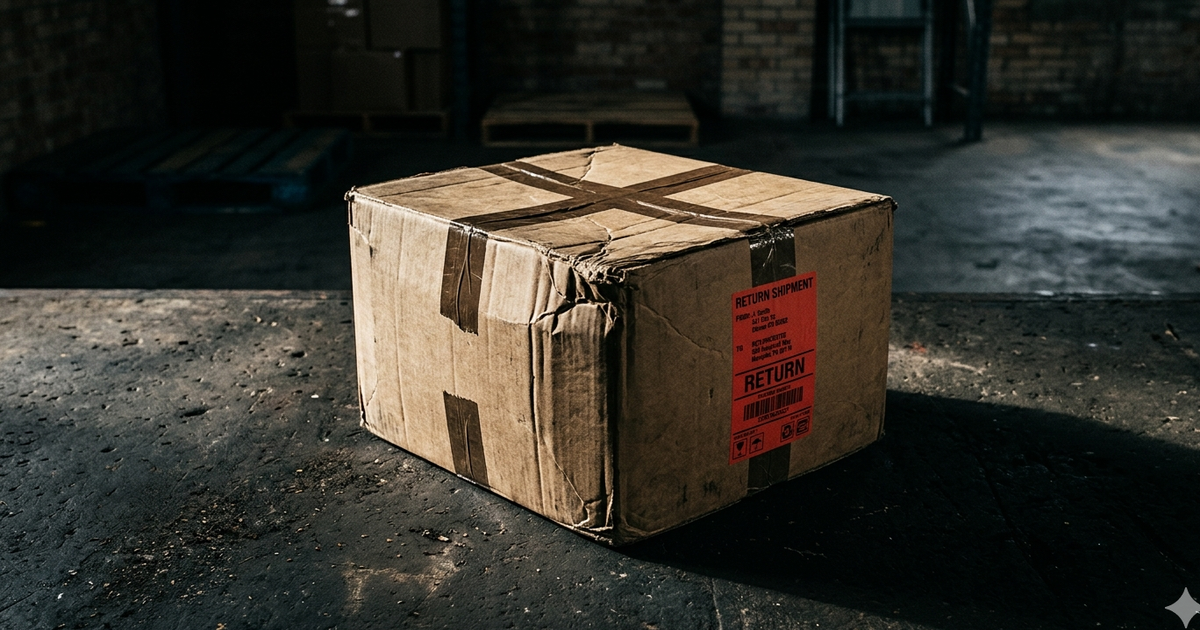
Without product identity, every warranty claim starts from zero context, and every return is a mystery box. With it, reverse logistics shifts from a cost centre to a value recovery operation.
The components are simple: a QR code on the product, a digital registration flow at point of sale, and a backend that tracks the product through ownership, support, and return. The orchestration is not. Connecting identity to triage logic, integrating with existing ERP and warehouse systems, and building the decision layer that routes each return automatically: that is where the engineering lives. But the hard part is the same as it always is: deciding to treat post-purchase as a system worth investing in.
Most manufacturers treat returns as a cost problem. The winners treat them as a data and recovery problem.
The manufacturers who make that shift are not just saving money on returns. They are building the data layer that powers everything else: warranty claims, customer retention, spare parts fulfilment, regulatory compliance, and secondary market value recovery. Reverse logistics is where the payoff starts to compound.
BrandedMark gives manufacturers the product identity layer that makes this possible, connecting every unit to its owner, history, and lifecycle data from the moment of registration. If you want to turn your returns process from a cost centre into a recovery operation, join the waitlist.