How HVAC Manufacturers Can Use Digital Product Identity
Key Takeaways
- A residential boiler or heat pump lasts 15–25 years, creating a multi-decade window for service revenue, parts sales, and direct customer relationships — all currently happening without the manufacturer in the room.
- The same QR code on the unit label serves completely different experiences for installers (commissioning checklists, Gas Safe docs) and homeowners (warranty, service reminders) based on context.
- Service reminders tied to a specific registered product achieve open rates 3x higher than generic email marketing.
- Digital product identity makes Gas Safe, F-Gas, and EU DPP compliance a byproduct of normal operations rather than a separate administrative burden.
Most HVAC manufacturers know everything about their products — the heat exchanger tolerances, the flue gas ratings, the modulation curves. What they don't know is who installed unit serial number 4728391-B, whether it's been serviced in the last 18 months, or whether the homeowner even knows their warranty is about to expire.
That gap — between the physical product and the people who own, install, and maintain it — costs manufacturers millions in missed service revenue, regulatory exposure, and preventable warranty claims every year.
Digital product identity closes that gap. And HVAC is one of the industries where it delivers the most value, fastest.
Why HVAC Is the Perfect Category for Connected Products
Not all product categories benefit equally from digital identity. HVAC sits in a rare sweet spot where almost every condition that makes the technology compelling is present at once.
Long lifecycles create long relationships. A residential boiler or heat pump lasts 15-25 years (BEAMA Heating Product Lifecycle Study, 2022). That's 15-25 years of potential service interactions, spare parts demand, regulatory documentation, and relationship-building — all of it currently happening without the manufacturer in the room.
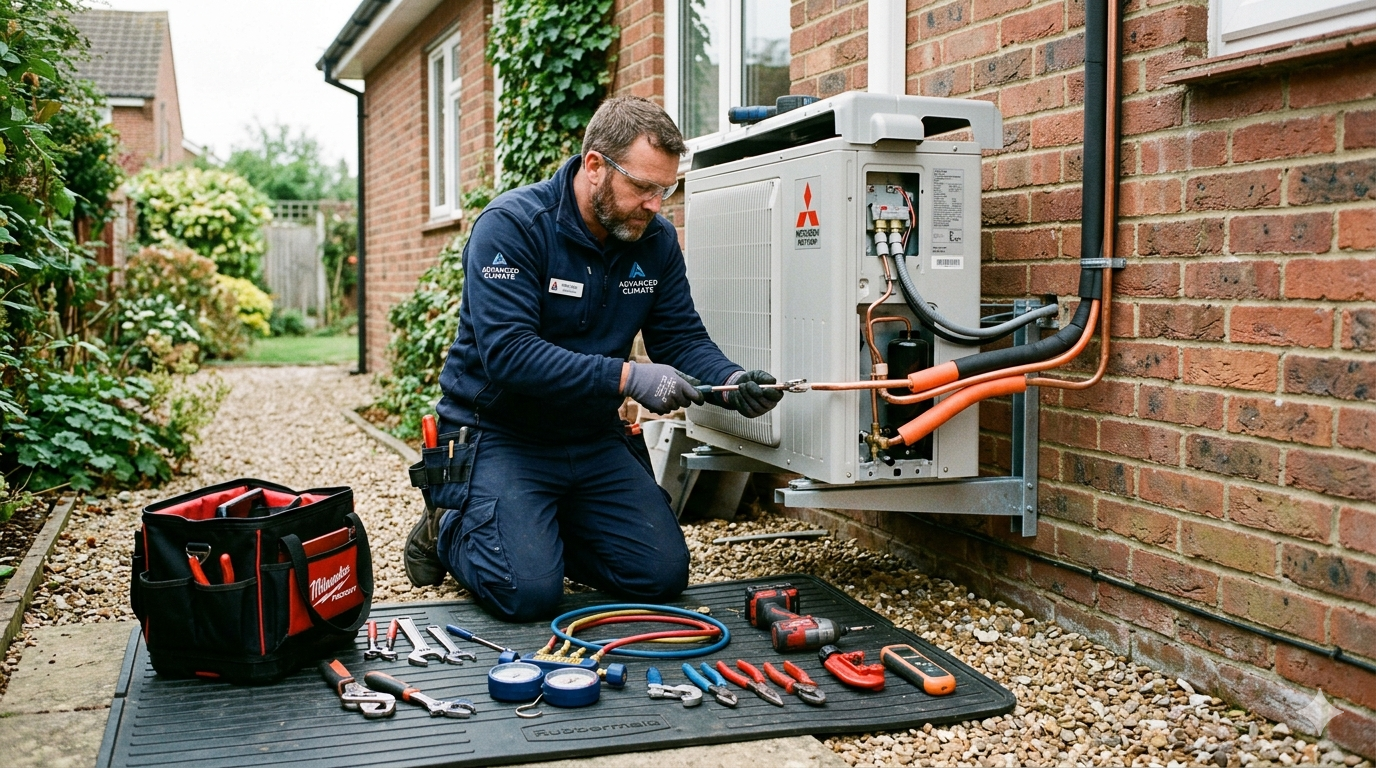
Professional installation creates a natural scan moment. Unlike a consumer appliance that a homeowner unpacks themselves, HVAC equipment is commissioned by a qualified engineer. That installer is already filling out paperwork, checking serial numbers, and completing documentation. Adding a product scan to that workflow is trivially easy — and captures verified installation data from a credentialed professional.
Mandatory annual servicing creates recurring touchpoints. In most markets, gas appliances require annual safety inspections. Heat pumps require periodic F-Gas compliance checks. These aren't optional — they're legally required. Every one of those service visits is a product scan opportunity, a data capture moment, and a chance to deepen the customer relationship.
Regulatory requirements create a compliance pull. Gas Safe registration, F-Gas certification, EPC ratings, and emerging EU Digital Product Passport rules all demand documented product history. Digital product identity doesn't just support compliance — it makes compliance automatic.
None of this requires retrofitting IoT sensors or building a connected device. It starts with a serialised QR code on the unit label — and a platform behind it that knows what to show, and to whom.
Five Use Cases That Deliver Real Value
The same physical identity marker on the product serves multiple stakeholders, each with different needs and different moments of engagement. Here's how HVAC manufacturers are putting it to work.
| Use Case | Stakeholder | Trigger | Outcome |
|---|---|---|---|
| Installer certification at commissioning | Heating engineer | Unit installation complete | Verified install record, Gas Safe documentation, manufacturer warranty activated |
| Homeowner registration and warranty | End customer | First scan after installation | Ownership confirmed, warranty started, direct data capture |
| Annual service reminders and booking | Homeowner | 11 months post-install or last service | Proactive engagement, authorised engineer booking, reduced lapse rate |
| Spare parts for engineers | Service engineer | Fault diagnosis or maintenance visit | Correct parts identified by serial, ordered direct, reduced mis-picks |
| End-of-life and replacement triggers | Homeowner | Unit age threshold or failure event | Upgrade pathway presented, trade-in offer, new unit registration started |
Use Case 1: Installer Certification at Commissioning
When a Gas Safe registered engineer completes an installation, they currently submit documentation through Gas Safe's own portal, fill in the benchmark commissioning checklist, and hand a paper record to the homeowner. It's fragmented, manual, and largely invisible to the manufacturer.
A digital product scan at commissioning changes all of this. The engineer scans the unit's serialised QR code, logs the installation date, records their Gas Safe registration number, and completes the benchmark digitally — all in one flow. The manufacturer now has a verified installation record tied to a specific serial number, a specific engineer, and a specific address.
That data is the foundation of everything that follows.
Use Case 2: Homeowner Registration and Warranty
Once the engineer leaves, the homeowner inherits the product. Traditionally, they receive a paper warranty card, a stack of manuals, and the hope that they remember where they filed it when something goes wrong three years later.
A product scan at handover — or a QR code link on the welcome card left behind — brings the homeowner into the digital experience. They see their specific unit, their warranty terms, their service history, and a direct line to manufacturer support. Registration takes under two minutes. The manufacturer captures a verified customer, a confirmed address, and consent for ongoing communication.
For a product with a 20-year lifecycle, that's a two-decade direct relationship — initiated at the moment the homeowner is most engaged.
Use Case 3: Annual Service Reminders and Booking
The servicing gap is one of the most costly problems in the HVAC industry. Unserviced units fail earlier, generate more warranty claims, and create regulatory liability. But manufacturers have historically had no way to reach the homeowner directly to prompt a service booking.
With a registered product and a known installation date, the manufacturer can send a proactive service reminder at the 11-month mark — every year, for the life of the unit. That reminder can include a booking link to an authorised engineer network, or a direct call-to-action to the manufacturer's own service arm.
This is not marketing spam. It's a genuinely useful communication that protects the customer's investment and the manufacturer's warranty obligations. Open rates for service reminders tied to a specific product the customer owns consistently outperform generic email marketing by a factor of three or more.
Use Case 4: Spare Parts for Engineers
When a service engineer arrives at a call-out, they often don't know exactly which variant of a unit is installed. Minor production runs, regional specifications, and component revisions mean that the "same" model might take three different heat exchanger gaskets depending on its serial number range.
A scan of the unit label resolves this instantly. The engineer sees the exact bill of materials for that specific serial, the superseded parts, and live stock availability. They can order directly to site or confirm the correct part number before they call the merchant. Mis-picks drop. First-time fix rates rise. Engineers spend less time on hold with technical support.
Internal link: how installer and field service teams use product identity in the field
Use Case 5: End-of-Life and Replacement Triggers
A 20-year-old boiler is a liability. It's likely inefficient, possibly non-compliant with emerging emissions standards, and statistically approaching the end of its serviceable life. The manufacturer knows this. The homeowner usually doesn't — until it breaks down in January.
With a known installation date and service history, the manufacturer can identify units approaching end-of-life and open a proactive conversation about replacement. That conversation — framed around energy savings, compliance, and reliability rather than a sales pitch — converts at significantly higher rates than cold outreach. The homeowner already trusts the brand. They're already in the product experience. The upgrade offer is a natural next step.
Installer View vs. Homeowner View: Same Identity, Different Experience
One of the most powerful aspects of digital product identity is that the same QR code on the unit label serves completely different experiences depending on who scans it.
The installer sees: commissioning checklists, Gas Safe documentation flows, technical specifications, wiring diagrams, error code lookups, and spare parts ordering. Everything a professional needs to install, commission, and service the unit correctly.
The homeowner sees: their warranty status, service history, a plain-language guide to the controls, a booking link for annual service, and safety information relevant to their specific model.
No app download required. No separate login portals. The same physical identity resolves to the right experience for the right person, every time — based on context, registration status, and the path they took to get there.
This matters because it eliminates the friction that kills adoption. Installers won't use a system designed for homeowners. Homeowners won't navigate a technical interface designed for engineers. A single identity with role-aware experiences serves both without compromise.
Internal link: what happens in the first 30 days after product registration
The Data Opportunity
The aggregate intelligence generated by a connected product estate is substantial — and almost entirely uncaptured by most HVAC manufacturers today.
Installation quality signals. If units installed by a specific contractor fail at three times the average rate, that's a training and certification issue the manufacturer needs to know about. Serial-level installation data makes this pattern visible before it becomes a warranty liability.
Service frequency and fault patterns. Which components fail most often, at what age, in which climatic regions? This data drives better product design, smarter stocking decisions, and more targeted service campaigns.
Parts demand forecasting. Knowing the age distribution of every registered unit in the field — and which parts have been ordered against which serial ranges — gives the supply chain team a demand signal months in advance. Seasonal spikes become predictable. Stockouts become avoidable.
Replacement cycle intelligence. The average time between a first fault call-out on an ageing unit and a replacement decision is around eight weeks (Heating and Hotwater Industry Council, Consumer Behaviour Research, 2023). Manufacturers who can identify that moment — and engage proactively — capture replacement sales that would otherwise go to a competitor who happened to have an engineer on site that day.
Internal link: the revenue streams hiding in your product scans
The Regulatory Angle
Compliance is usually framed as a cost. Digital product identity turns it into a capability.
Gas Safe registration requires documented proof that a qualified engineer commissioned a gas appliance. Currently that proof lives in a paper benchmark, a Gas Safe portal entry, and — if you're lucky — a photograph on the engineer's phone. It's fragmented and difficult to audit.
F-Gas regulations require documented records of refrigerant type, quantity, and any additions or removals at each service visit. For heat pump manufacturers, this is a growing compliance burden as enforcement tightens across GB and the EU.
The EU Digital Product Passport — coming into force progressively from 2026 — will require manufacturers of certain product categories to provide a machine-readable digital record of a product's environmental profile, repairability, and component composition throughout its life.
A digital product identity platform that captures installation, service, and parts data already holds most of what these regulations require. The compliance record isn't something you build separately — it's a byproduct of the connected product experience you're already running.
How This Compares to What's Already Out There
Vaillant's myVAILLANT platform and Worcester Bosch Connected have both moved in this direction, building app-based experiences primarily for connected smart controls. Registria has offered cloud-based product registration for consumer brands for years. These are genuine steps forward.
The difference with a purpose-built product identity platform is the depth and flexibility of the data layer beneath the experience. A smart controls app tells you what the boiler is doing right now. A product identity platform tells you everything that's happened to that unit across its entire life — who installed it, who serviced it, which parts were fitted, whether the warranty is current, and what the homeowner's engagement looks like.
The former is a feature. The latter is an operating system.
Frequently Asked Questions
Does this require the unit to be internet-connected or IoT-enabled?
No. Digital product identity works with a standard serialised QR code printed on the unit label at the factory. No connectivity in the unit itself is required. The intelligence lives in the platform, not the product. This means it works for every unit you ship today, without any hardware changes.
How does the installer scan work if engineers are often working in plant rooms or utility cupboards with poor signal?
The scan flow is designed to work offline-first, with data syncing when connectivity is restored. Engineers working in basements or commercial plant rooms can complete a commissioning record without a live connection. The record uploads automatically when the device reconnects.
What happens to the product identity when a property changes hands?
Ownership transfer is handled through the platform. The outgoing owner can transfer the product to the new owner's details, or the new owner can claim the product by scanning the unit and providing proof of address. The full service history and warranty documentation carries over — which has real value for conveyancing and property surveys. It's increasingly common for solicitors to request documented appliance service history as part of a property transaction.
The Window Is Open — But Not for Long
HVAC manufacturers who move on digital product identity now will build a five-to-ten-year data advantage over competitors who wait. Every unit shipped without a connected identity is a customer relationship that never starts, a service visit that happens without the manufacturer in the room, and a compliance record that lives on paper somewhere in a filing cabinet.
The units you ship this year will still be in service in 2045. The question is whether you'll have a relationship with the people living with them — or whether you'll remain a name on a data plate that nobody reads.
BrandedMark gives every HVAC product a digital life from commissioning to end-of-life. The same platform that handles installer certification handles homeowner registration, annual service engagement, and regulatory compliance — across every unit, every market, every lifecycle stage.
Your products are already in the field. Start connecting them.